Executive Overview
Clarity is an AI decision-intelligence platform designed to help people navigate high-stakes choices. Traditional software tools address complex decisions by aggregating more listings, data points, or search filters. In practice, this creates information overload rather than clarity.
Clarity takes the opposite approach: instead of surfacing more raw data or delivering an unexplainable AI recommendation, it provides a structured framework for thinking, capturing priorities, rendering trade-offs transparent, and exposing AI reasoning at every stage.
While the framework extends across multiple high-stakes domains (Career, Finance, Education, Business), this case study focuses on the featured experience: First-Time Home Buying.
Role: Lead Product Designer · Team: PM, 2 AI Engineers, Frontend Engineer, Domain Experts · Deliverables: Decision Architecture, User Research, Human × AI Workflow, High-Fidelity UI, Interactive Prototypes
The High-Stakes Challenge
People rarely get stuck because information is missing. They get stuck because consequential decisions carry too many competing variables and personal risks to weigh mentally all at once.
First-time home buying illustrates this breakdown vividly: buyers spend weeks juggling financial constraints, commute limits, neighborhood safety, and long-term resale potential across dozens of browser tabs, yet uncertainty remains high because financial, practical, and emotional priorities pull in opposite directions.
Core Design Tensions
- Information Depth vs. Cognitive Overload: Presenting detailed disclosures without overwhelming the buyer.
- Objective Constraints vs. Subjective Values: Balancing hard numbers (budget, square footage) with personal priorities (vibe, safety feel).
- AI Guidance vs. Human Agency: Delivering intelligent recommendations while keeping the user in full control of every decision.
Research-Backed Design Goals
Intended Qualitative Experience
* Qualitative scenario objectives derived from research synthesis
Qualitative Goal
Decision Confidence
Help people feel more confident in evaluating complex, high-stakes alternatives.
Qualitative Goal
Decision Clarity
Make priorities, trade-offs, and AI recommendations transparent and easy to understand.
Qualitative Goal
Lower Cognitive Load
Reduce the mental effort required to compare options and reason through trade-offs.
Research as the Story
To understand where decision-making breaks down, I conducted qualitative interviews and mapped the decision journey with first-time home buyers.
The Core Insight
Key Insight
The Strategic Shift
For home buying, the research forced a fundamental reframe: people do not need more property listings. They need help choosing between them. I shifted the product architecture from an information-aggregation search engine to a decision-structure engine.
Design Decision: Re-architecting from Search Grid to Choice Matrix
What We Knew Initially
Traditional real estate platforms rely on filterable search grids sorted by price or date added.
What Research Discovered
Search grids optimize for item retrieval, but increase cognitive fatigue when choosing between 4-5 viable properties.
What Changed & Decision Made
Prioritized explicit criteria alignment and trade-off comparison over endless scroll feeds.
Shifted the primary experience from a listing feed to a side-by-side decision workspace.
Why This Direction & Trade-off
Buyers make better decisions when evaluating a small set of curated options against explicit criteria rather than browsing hundreds of unranked listings.
Research → Design Connections
Every major interface mechanism in Clarity was directly informed by a specific research finding:
Research → Design Connection
Priority Weighting Before Option Exploration
01 · Research Finding
Users presented with raw property data immediately got lost in details before agreeing on what mattered most.
02 · Design Implication
The product must help users establish and weight priorities before showing property listings.
03 · Design Decision
Introduced an AI-assisted Discovery flow capturing financial limits, commute caps, and lifestyle non-negotiables up front.
04 · Product Solution
Structured Discovery Step with weighted priority sliders and constraint boundaries.
Research → Design Connection
Side-by-Side Trade-Off Visibility
01 · Research Finding
Buyers struggled to weigh financial savings against lifestyle sacrifices across multiple browser tabs.
02 · Design Implication
Trade-offs between competing options must be explicitly calculated and visually highlighted.
03 · Design Decision
Created a Trade-Off Matrix displaying 'What You Gain' vs. 'What You Sacrifice' for each top contender.
04 · Product Solution
Transparent Trade-Off Panel with explicit sacrifice vs. gain callouts.
Research → Design Connection
Explainable & Challengeable AI Reasoning
01 · Research Finding
Users distrusted black-box AI scores that ranked properties without exposing the mathematical or logical rationale.
02 · Design Implication
AI recommendations must show their work and allow users to challenge or override underlying assumptions.
03 · Design Decision
Built Explainable AI Cards mapping match scores directly to user-defined criteria with interactive override toggles.
04 · Product Solution
Plain-language AI Reasoning cards with editable weight controls.
Human × AI Collaboration
Designing Clarity required establishing a strict division of labor between artificial intelligence and human judgment.
What AI Accelerates in Clarity
- Research & Document Synthesis: Summarizing property disclosure documents, financial terms, and local market reports.
- Multi-Variable Pattern Finding: Cluster mapping competing property attributes against budget & commute constraints.
- Trade-Off Calculation: Instant mathematical calculation of financial vs lifestyle sacrifices across options.
- Explainable Reasoning Generation: Generating plain-language explanations for why a property aligns with user priorities.
What Human Judgment Owns
- Problem & Value Framing: Setting personal life priorities, risk tolerance, and emotional non-negotiables.
- Challenging Assumptions: Questioning AI suggestions, testing market edge cases, and adjusting model weights.
- Evaluating Qualitative Context: Weighing qualitative factors like neighborhood feel and long-term family vision.
- Final Decision Ownership: Making the final commitment and taking full accountability for the choice.
My Ownership & Leadership: As Lead Product Designer, I framed the decision architecture, authored the Human × AI interaction principles, designed the high-fidelity UI systems, and led usability validation sessions.
Product Experience & Final UI
Clarity guides users through five adaptive stages:
Product Experience Narrative
5 Key Moments in the Clarity Decision Experience
Each interface screen was engineered to solve a specific cognitive bottleneck in high-stakes decision making.
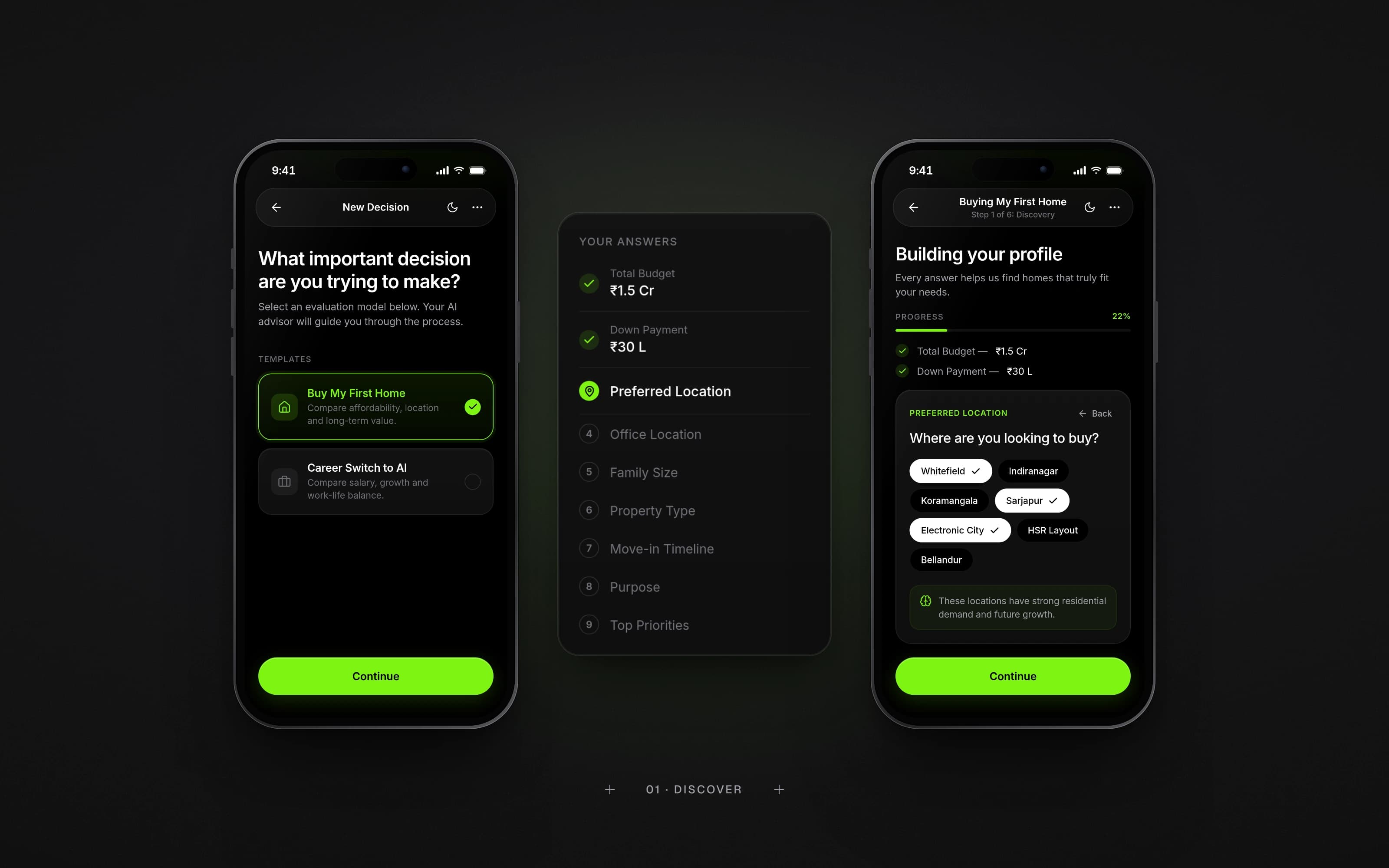
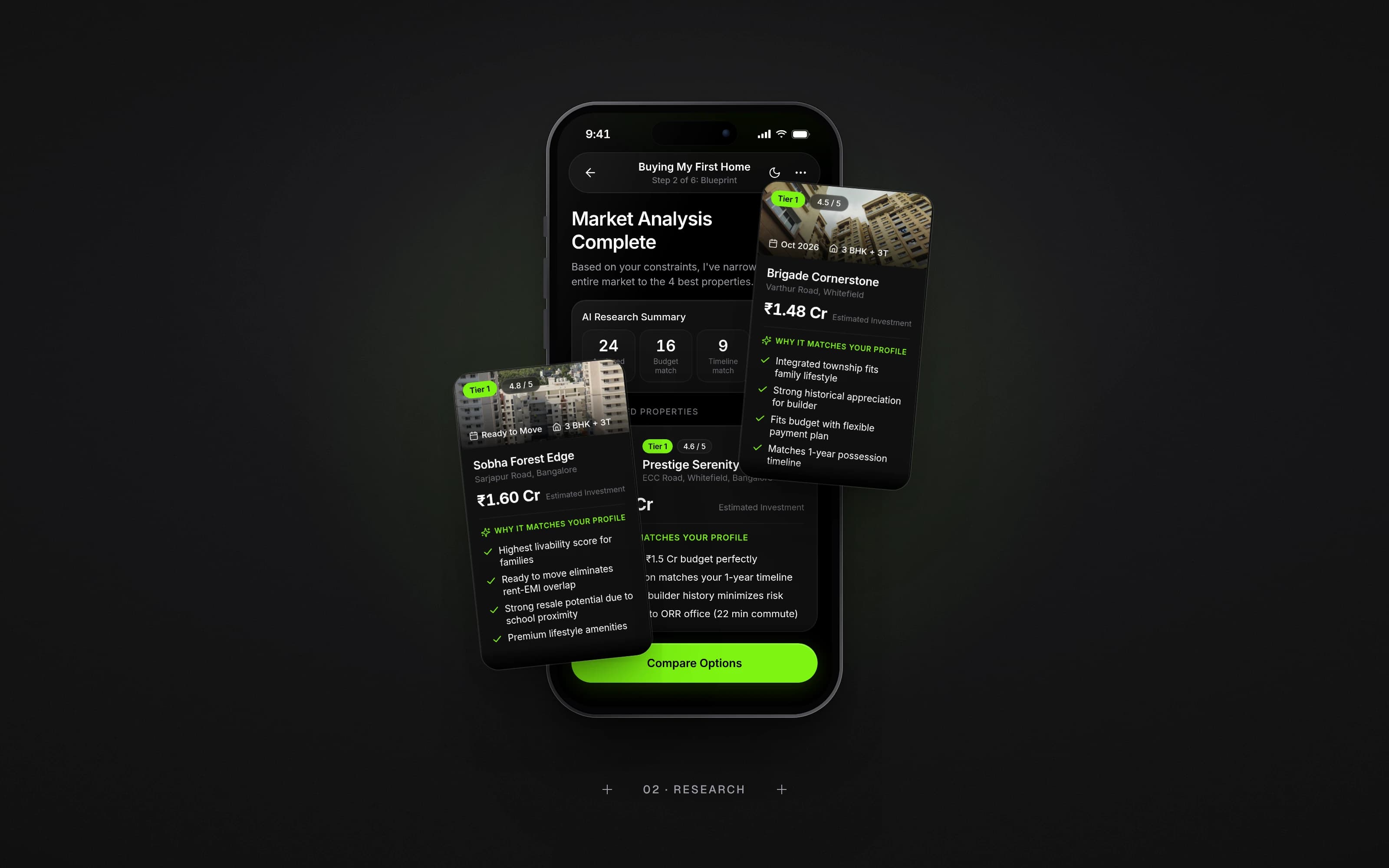
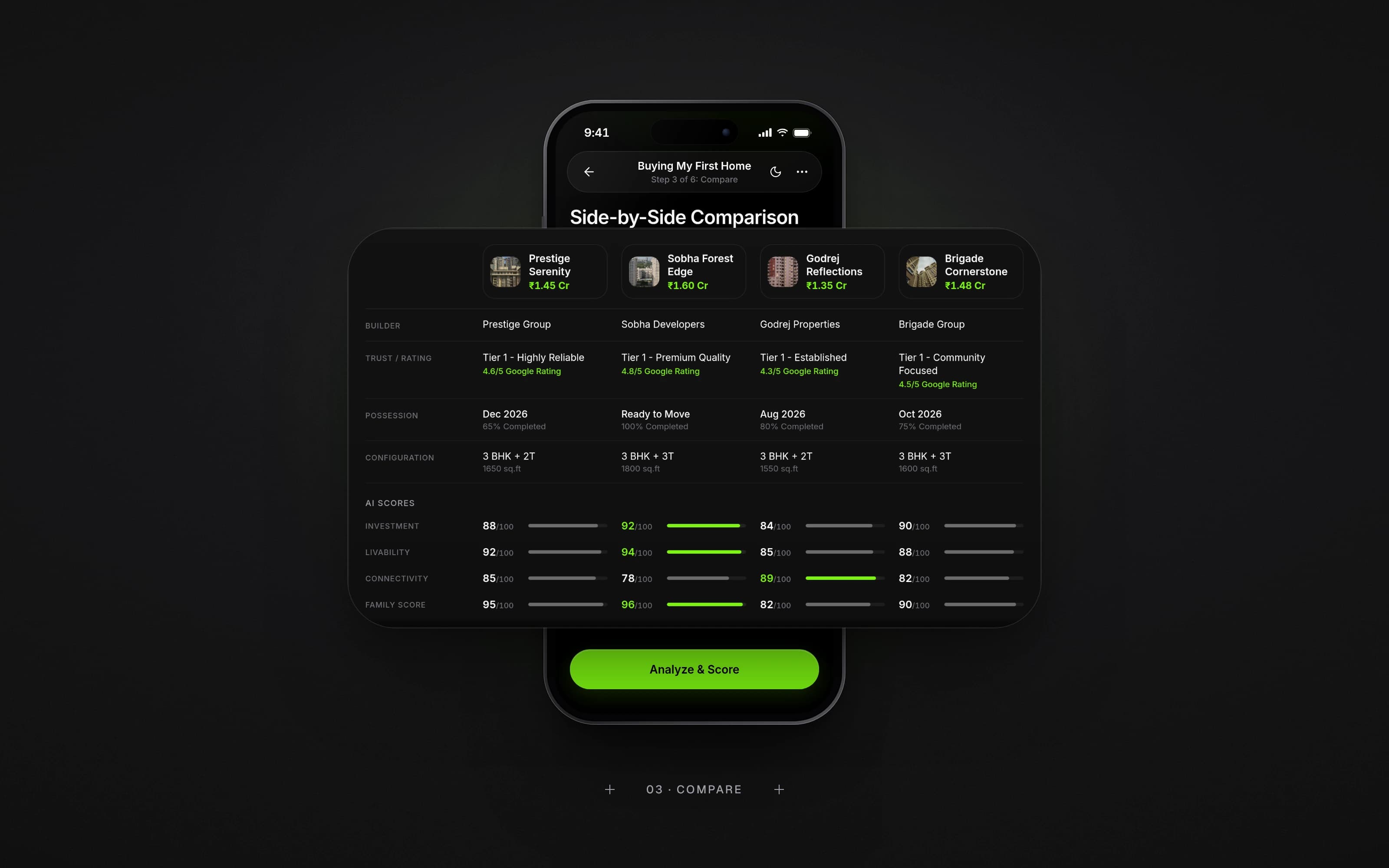
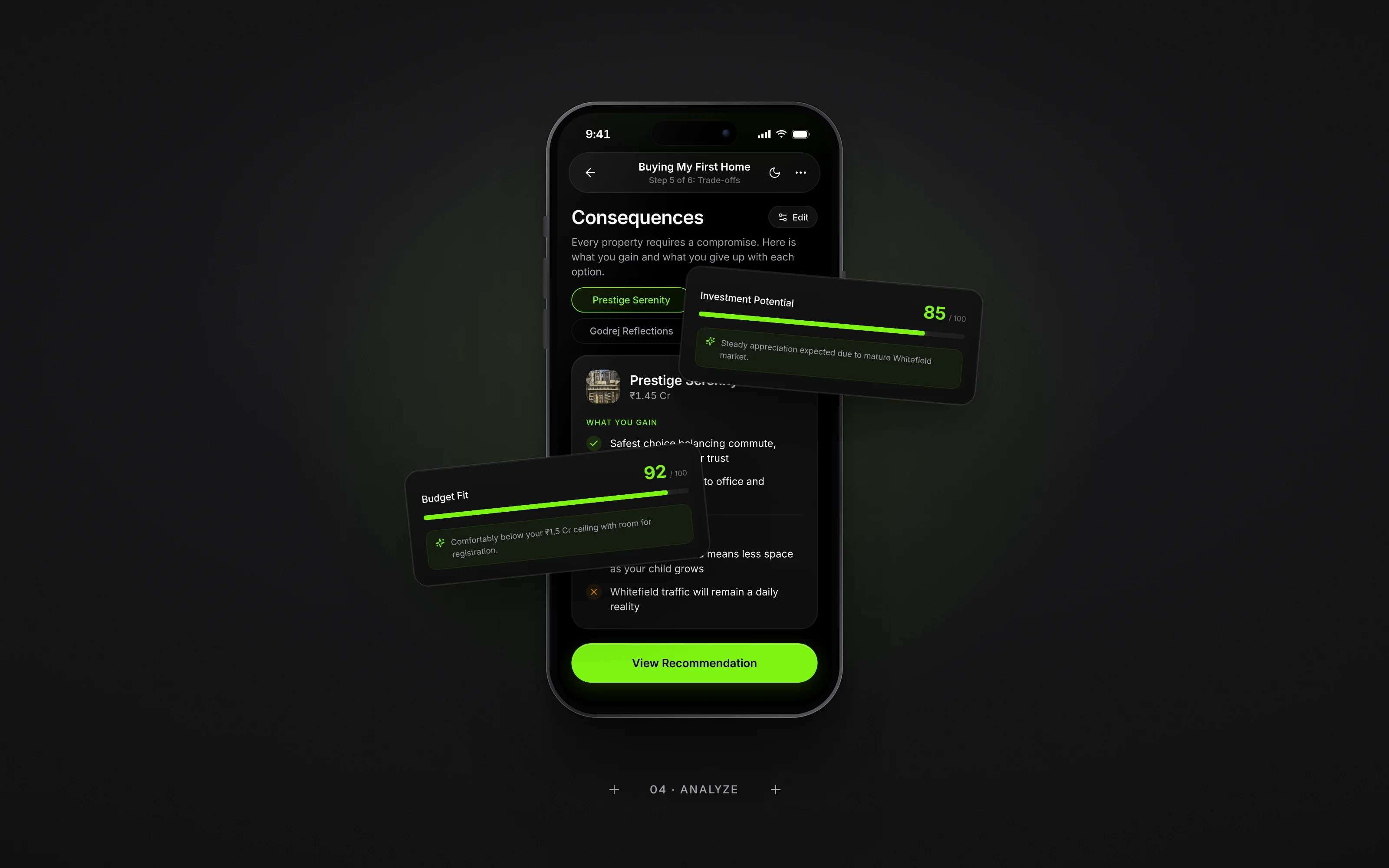
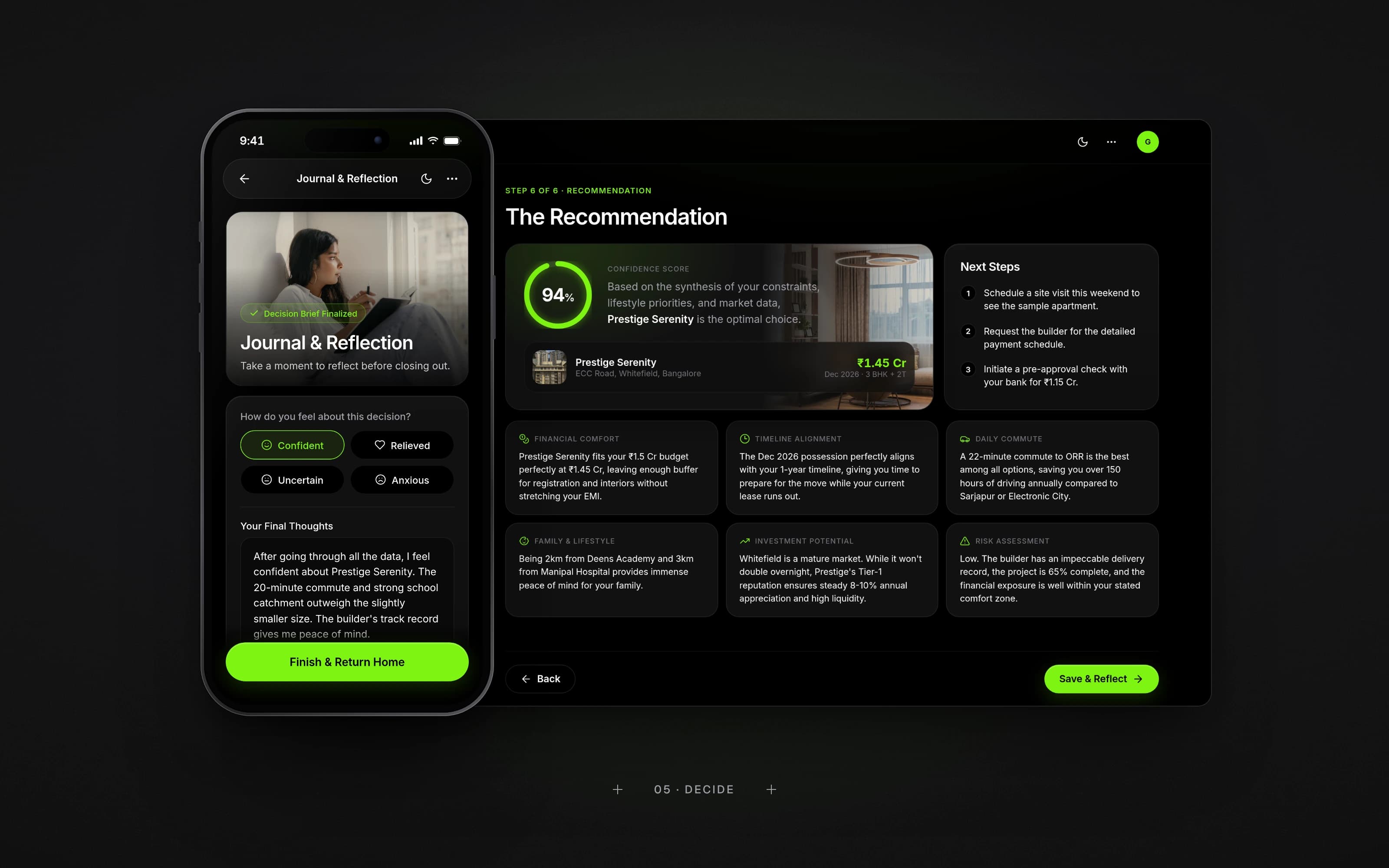
Slide 1 of 5: Discover, Starting the Decision
Validation & Observed Results
To evaluate the product's impact, I led qualitative scenario testing focused on user clarity and decision confidence:
- Reduced Decision Anxiety: Users reported significantly less overwhelm when evaluating competing options through an explicit trade-off matrix.
- Increased AI Trust: Exposing AI reasoning logic in plain language increased user confidence in system recommendations and encouraged users to adjust model criteria.
- Preserved Agency: Users felt in complete control of the final choice, viewing AI as an analytical assistant rather than an authoritative decision-maker.
Personal Reflection & Key Takeaways
- More Information ≠ Better Decisions: True decision intelligence comes from structure, priority weighting, and transparent trade-offs, not from consuming more raw data.
- AI as a Decision Partner, Not an Authority: Technology is most empowering when it accelerates human reasoning while leaving final judgment firmly with the user.
- Designing for Trust Requires Transparency: Trust in AI is built by showing the work: exposing assumptions, explaining reasoning, and making model weights editable.
Next Project
Connected Service Operations Platform →